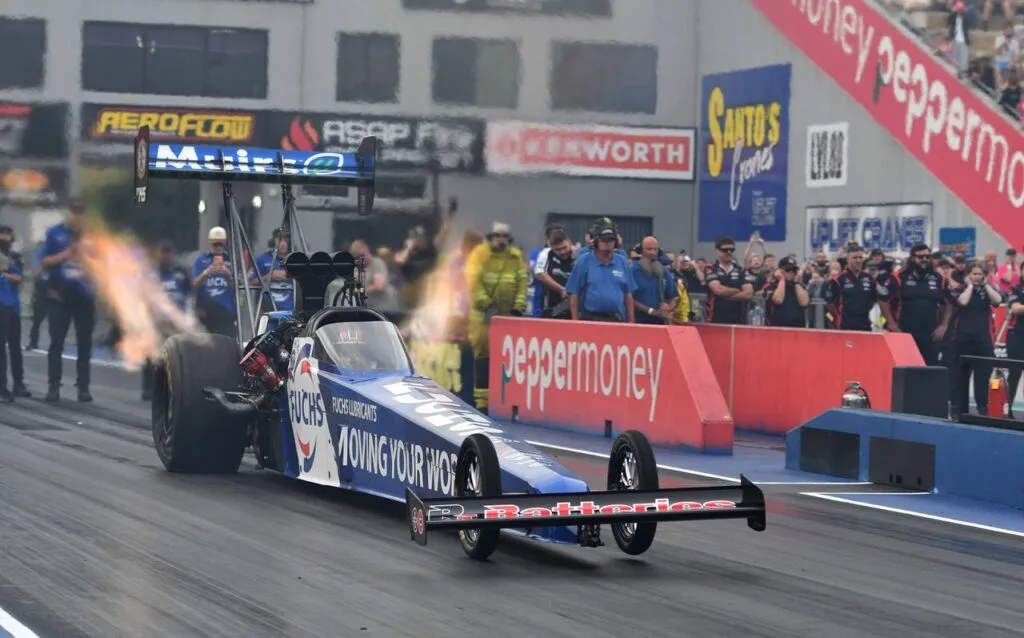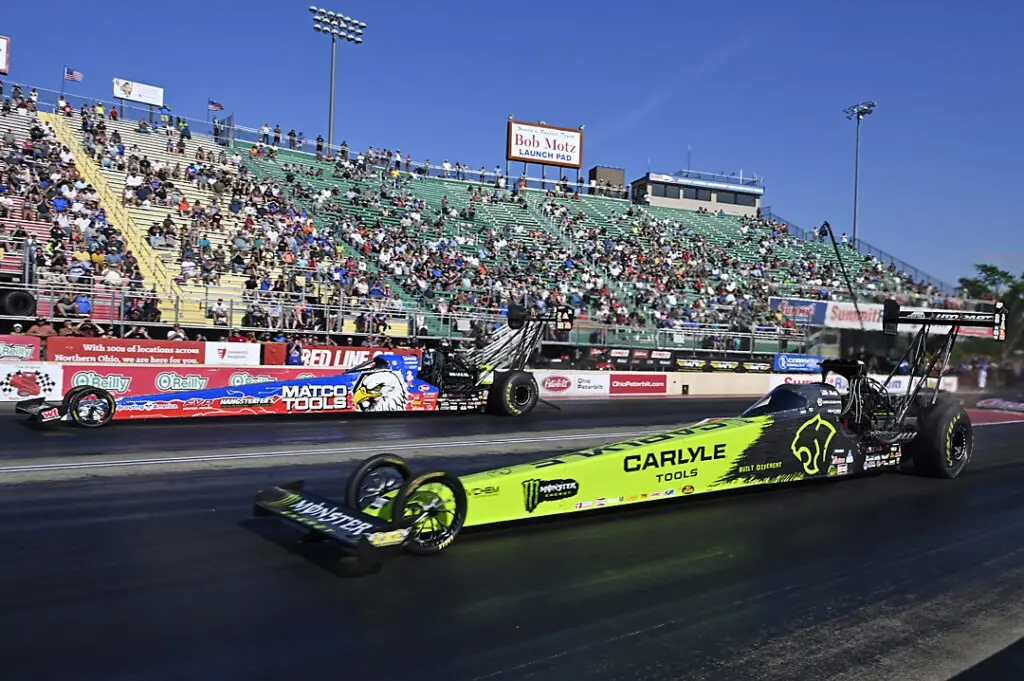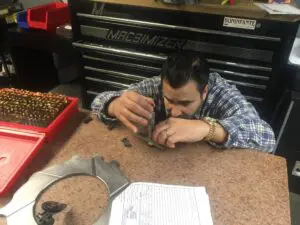


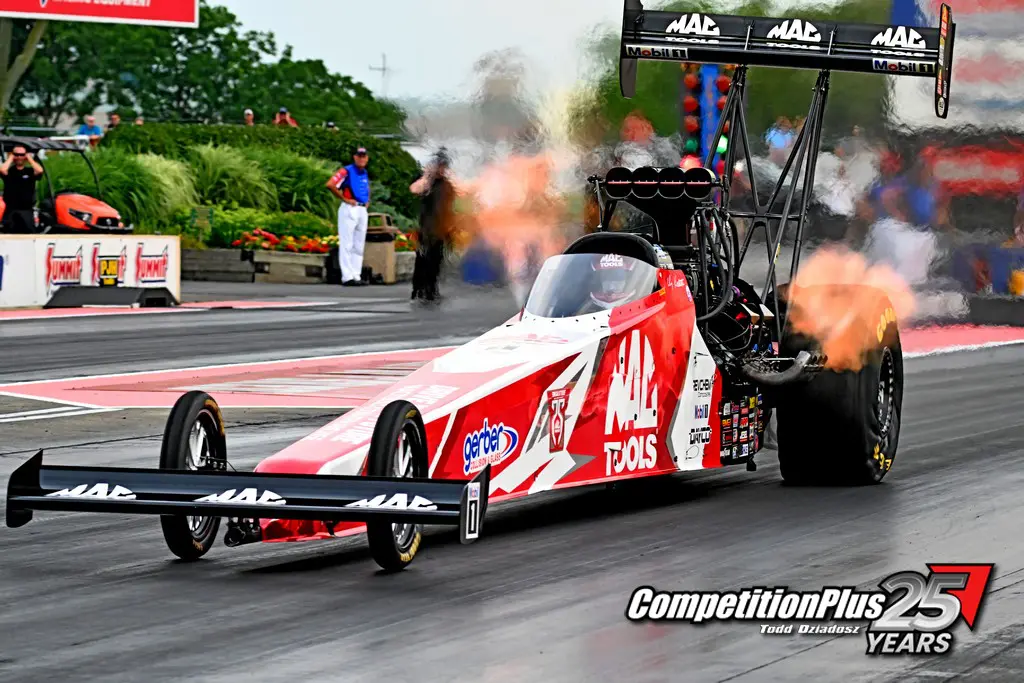
Most fans see a Top Fuel dragster leave the starting line and stand awestruck at 11,000 horsepower at work. Crew chiefs see data. Drivers see a finish line. Rob Boninfante sees molecules.
That approach has made Boninfante one of the most trusted suppliers in nitro racing, building clutch components that live in an environment where microscopic differences can become the difference between a championship-winning or championship-losing season. It has also taught him there is no such thing as vacation time for the companies responsible for keeping the sport’s quickest and most volatile race cars alive.
Tuners can spend their lives looking for another hundredth of a second. Boninfante spends his trying to make sure their search doesn’t destroy the parts connecting that horsepower to the racetrack.
“They’re apex predators,” Boninfante said. “The teams you’re dealing with, the guys that are running these cars, they’re apex predators, the drivers, the same thing. These guys are living for winning. And you can’t let somebody else outwork you.”
Boninfante doesn’t just hold that status for Alan Johnson, Jimmy Prock or the championship crew chiefs who traditionally run at the front of the pack. He believes the same unrelenting drive extends to every company responsible for building the critical pieces inside a nitro car.
“Everybody that’s manufacturing any kind of a critical part for these cars, you’re making changes,” Boninfante said. “If something has a problem, you’ve got a problem, and it’s right now and it’s got to be fixed right now. A lot of times there’s nobody to help you. You have to do these things yourself or with your small internal group. It’s very different.”
it’s the never-ending tempest race fans never see. They hear someone blame a “bad batch” of clutch discs or wonder why a dominant team suddenly can’t get down the racetrack. Boninfante hears something far different.
“There really isn’t such thing as perfect,” Boninfante said. “Everything’s finite, and there is really no such thing as the same in this one. Nothing is ever the same. It meets the upper and lower control limit.”
A clutch disc which appears identical under ordinary inspection can reveal subtle differences when magnified thousands of times. Those differences might never matter in an ordinary performance application. But when it comes to a nitro clutch, they can change everything.
“You’re dealing with molecules and interactions that are microscopic,” Boninfante explained. “Very small things can add up to be differences in these cars today.”
Add in the valotility of nito engine, and those differences can quickly be off the chart in a negative aspect.
Today’s combinations produce substantially more horsepower than the cars Boninfante grew up watching. The reality is that the chassis are stiffer and their ires continue to evolve. The track prep improves, along with data acquisition systems that reveal details teams couldn’t have envisioned back in the day.
“The more the torque and horsepower, the more you have to slip the clutch and control the heat and the friction output, the smaller that window gets on the part that you’re manufacturing,” Boninfante said.
At the center of it all is heat. It’s the one thing Boninfante and every nitro crew chief are trying to control, even if they’re attacking the problem from opposite ends of the trailer. Many fans understand the clutch slips during a run. Few understand what that actually means.
“When it’s doing that, it’s going through molten liquid phases on the surface,” Boninfante said. “It’s very, very high temperature, and to have everything act right while it’s going through these transformations is very difficult.”
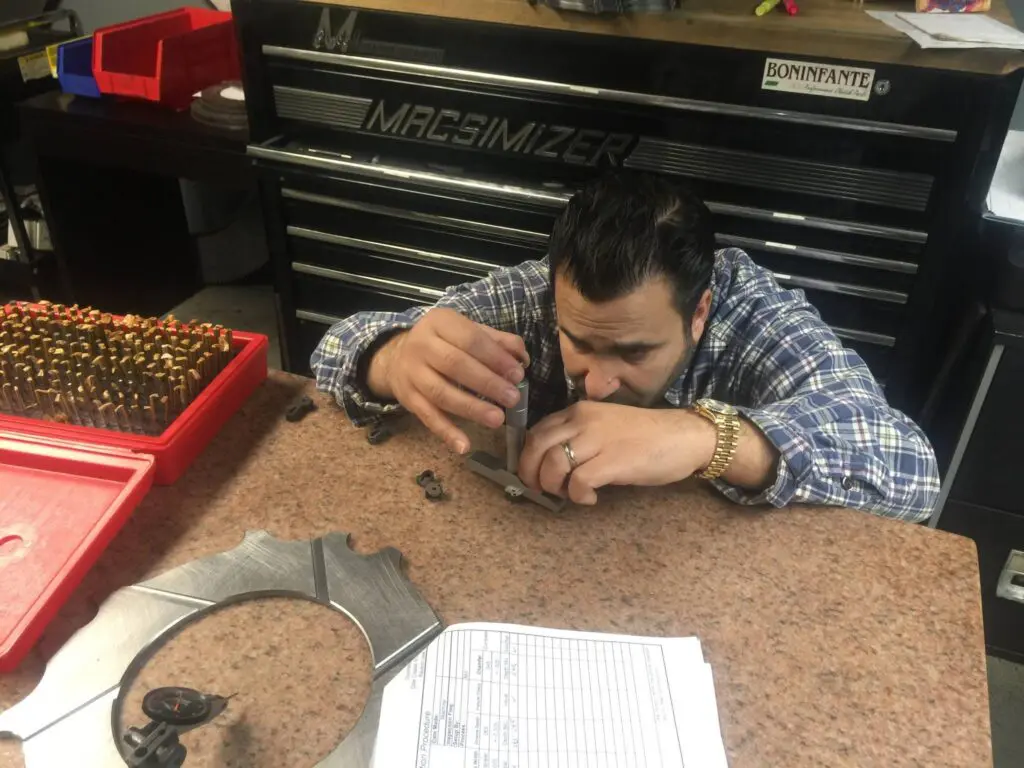
Those conditions leave Boninfante with no offseason. As race teams gather more information, manufacturers such as Boninfante inherit more questions.
“You start seeing things in the background, you have to research it,” Boninfante said. “Sometimes your research leads to having to develop something. When you’re doing research, you’re spending money. When you’re doing development, your development is eating money.”
Resting on one’s laurels in this industry? Well, that’s just crazyspeak.
“It’s like a Tyrannosaurus Rex,” Boninfante said. “It just eats money.”
The expense isn’t theoretical. Testing can send electrical costs soaring by five figures in a single month. Add in specialized instrumentation that costs tens of thousands of dollars before producing a single answer. There’s also new machining fixtures, programming changes and overtime become routine because one customer wants a different groove pattern on a clutch floater.
Every solution creates another invoice on both sides of the fence.
“So yes, it’s not a business that’s something that you can put on autopilot,” Boninfante said. “You wish you could make things just run on autopilot. It doesn’t work like that.”

Boninfante knows every improvement made by a clutch manufacturer eventually becomes another problem to solve because the sport refuses to stand still.
“The torque and horsepower are increasing,” he said. “The track may change. Tires change. They stiffen chassis up. All these things change. It’s like an action and a reaction situation.”
Every gain comes with a bill. The money Boninfante earns solving one problem usually finds its way back into the next round of testing, new tooling or another engineering project because the next challenge is already waiting. That’s simply the price of staying relevant in nitro racing.
“If you want to build parts and make money and not have headaches, you would stay the hell away from this line of work,” he said. “You would absolutely stay away from it.”
Born into one of drag racing’s best-known families, Boninfante grew up immersed in nitro competition. His father, Nick Boninfante, promoted races before becoming one of the sport’s respected manufacturers. His brother, Nicky Boninfante, built a reputation as one of drag racing’s premier crew chiefs and today works with Rick Ware Racing.
Racing wasn’t a profession Rob discovered. It was the language spoken at home. That upbringing eventually led beyond drag racing.
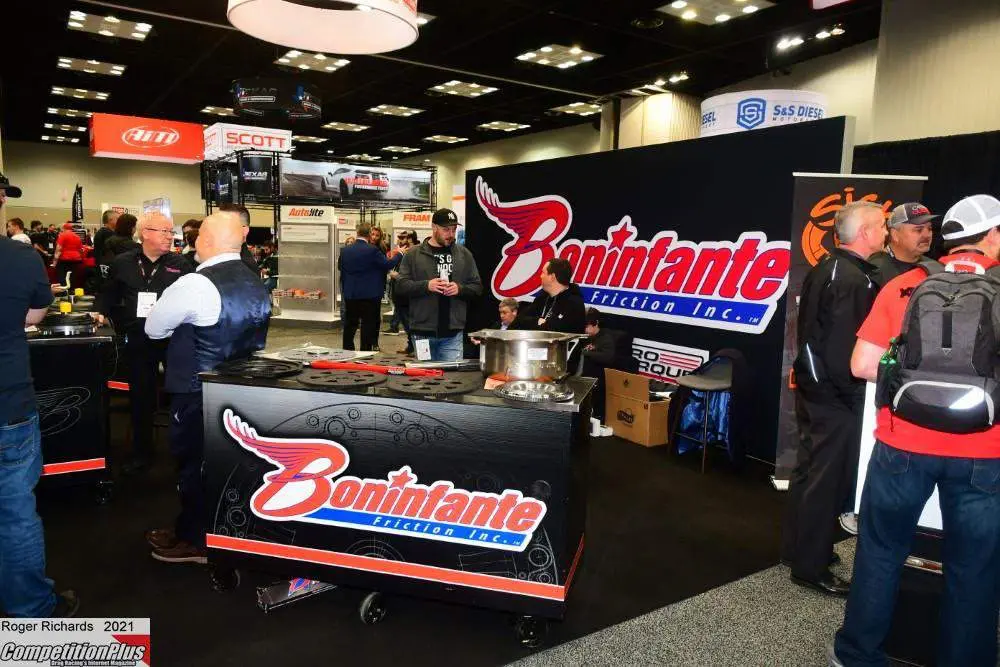
Boninfante’s work in drag racing has exposed him to aerospace development with companies including Phantom Works, Rolls-Royce and Hamilton Sundstrand, experiences that deepened his understanding of metallurgy, stress analysis and materials engineering. Those lessons eventually found their way back into drag racing.
When input shafts began failing years ago, Boninfante helped develop replacements that dramatically extended service life. More recently, when gear failures plagued teams, he again stepped outside his normal business, not because it promised new revenue but because racers needed help.
“I didn’t do that as per se business,” Boninfante said. “I did that mainly just try to help the race teams not have that problem.”
Helping racers succeed remains his MO.
“I have a very high level of love and care for what we’re building and the customers that we’re dealing with in the sport,” Boninfante said. “I really put everything I can into it.”
This level of commitment comes with sacrifice.
“There is no work-life balance,” Boninfante admitted. “Your life is consumed by what you’re doing. By trying to win or help people win.”
Boninfante doesn’t see himself alone in the daily grind. He sees it in every championship crew chief. It’s Every engine builder and cylinder head manufacturer. Every supplier whose name appears on the side of a trailer instead of the side of a race car can feel Boninfante’s pain.
“The passion level for all them guys is so high,” Boninfante said. “You don’t get to the level these guys are at unless you’re the best in the world. That takes that level of passion.”
In Boninfante’s world, complacency is more dangerous than failure.
“You better try to keep up with them,” he said. “You better work real hard at what you’re doing. There’s no place for blame on other people, and there’s no place for complacency in this industry.”
For all the science, metallurgy and engineering, Boninfante ultimately reduces success to something much simpler.
“If you’re not passionate about what you’re doing,” he said, “you’re a liability, not an asset.”